Urology: Beyond the Procedure

For many physicians, urology is still shorthand for procedures or late-stage disease. For Dr. Premal Patel, a Winnipeg urologist and co-founder of the Men’s Health Clinic Manitoba, the specialty is far broader. And it’s increasingly central to conversations about access and the sustainability of Manitoba’s health system.
For Dr. Sabeer Rehsia, there is a large medical component to his work with patients that is rewarding; it’s not all just about surgery.
Much of Dr. Patel’s practice focuses on men’s health: infertility, low testosterone, erectile dysfunction, Peyronie’s disease, and benign prostatic hyperplasia. But he is quick to reframe these as more than separate issues. Many, he says, are early warnings of something larger.
That reframing is the heart of his message to colleagues. A man presenting with erectile dysfunction may be presenting, unknowingly, with the first sign of vascular disease. The consultation becomes a doorway to cardiovascular screening that might otherwise never happen.
“A lot of what I do falls under men’s health, but so much of it is really about prevention. Many of these conditions are early markers for broader health issues, especially cardiovascular disease.” — Dr. Premal Patel
“It’s often the first time patients have heard that erectile dysfunction can be linked to heart health. That represents both a gap and an opportunity when it comes to education.”
Dr. Rehsia has noted similar themes in his own practice, especially when counseling patients about the potential causes of their urologic disease and the common associations with other conditions.
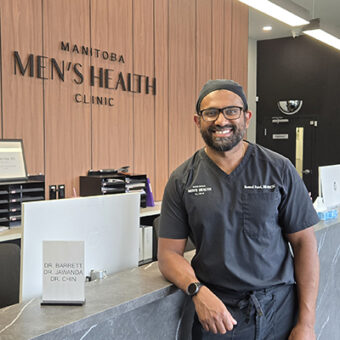
A specialty that spans the lifespan
Urology is often underestimated, Dr. Patel said.
“Urology is a surgical specialty of the entire genitourinary system,” Dr. Patel said. “We do major procedures — kidney surgery, cancer care — but we also manage chronic conditions and follow patients long term. It’s really a blend of surgery and medicine.” For Dr. Sabeer Rehsia, who has practiced urology in Manitoba for the past 14 years, that same breadth is what drew him to the specialty in the first place. He knew early on he wanted to work in a surgical specialty with a strong medical management component and says urology’s mix of procedural work like cystoscopy and major open surgery is part of what keeps the work engaging.
Doing more with the same?
Demand is the recurring theme. Manitoba’s urological workforce has not kept pace with a growing and aging population, and the gap forces difficult triage decisions every week.
There are 21 urologists in Manitoba, a number that falls short considering population growth and aging. Urologists are seeing more complex disease, more volume, and not enough capacity in the system.
In practice, that means urgent cases, including catheter-dependent patients, or those battling aggressive cancers move to the front of the line, while others wait longer than anyone would like.
“We’re prioritizing urgent cases, which means others wait. That’s the reality we’re working in,” said Dr. Patel.
Dr. Rehsia, who works across multiple sites in Winnipeg including Victoria Hospital, Grace Hospital, and CancerCare Manitoba, said that reality is compounded by how the specialty is staffed. Community-based coverage means being on call on weekends, and unlike some other specialties, urology in Manitoba largely lacks team-based support such as house medical officers, physician assistants, or clinical assistants.
“We have to do everything from taking histories, to booking procedures and rounding,” said Dr. Rehsia. “It’s a high volume of work on our own.”
Having trained and worked in Manitoba’s system for over a decade, Dr. Rehsia brings a particular vantage point to the retention conversation.
“We’re a small province and specialty. We work well together, but if we want people to come here, there has to be a good environment here for them to succeed if we expect them to stay.”
Available technology also hasn’t kept up with new developments in treatment, including surgical robotics, as one example.
Beyond clinical care, Dr. Patel holds educational leadership roles and recently helped launch Manitoba’s first fellowship in urologic subspeciality training in male infertility, sexual medicine and cancer survivorship — a step toward growing the very workforce both physicians describe as stretched.
Building a different model of care
Part of Dr. Patel’s response has been structural. After returning to Manitoba in 2019 and completing his fellowship in male infertility and sexual medicine, he and Dr. Jay Nayak opened the Men’s Health Clinic Manitoba in 2022, the first specialty-run clinic of its kind in Canada, with expertise spanning infertility to prostate cancer management.
The clinic offers a self-referral pathway built in partnership with primary care. The design is deliberate: see patients faster, take pressure off hospitals, and create a setting where men feel able to raise sensitive concerns.
“Men’s Health Clinic has an accredited operating room where we have decanted the main hospitals with much-needed capacity for prostate surgery and other urological procedures that can be performed on an outpatient basis.”
“Having a dedicated outpatient centre has allowed us to see patients faster, relieve pressure from hospitals, and create an environment where patients feel comfortable talking about sensitive issues.”
The response from patients has been simple and consistent.
“The most consistent feedback is simply that people are grateful a place like this exists,” said Dr. Patel.
Dr. Rehsia has long believed community-based urology would be able to better service more people with appropriate support structures that allow for faster assessment of consultations, ability to book appropriate surgical cases, and provide more thorough urologic care to the people who need it.
“There’s a wide range in urology and the specialty is always evolving. You’re constantly learning.” — Dr. Sabeer Rehsia
What every physician should know about urology
Between them, Dr. Patel and Dr. Rehsia offer a few practical takeaways for colleagues across specialties:
- Treat sexual dysfunction as a screening opportunity. Conditions like erectile dysfunction can be early markers for cardiovascular disease and warrant a broader look.
- Consider the male pelvic floor. Pelvic floor issues are more common in men than many realize, and physiotherapy can be transformative.
- Use eConsult to close the gap. Many concerns can be addressed quickly through eConsult, sparing patients long waits for in-person referral.
- Send focused referrals. Dr. Rehsia notes he often receives consults at two extremes: too little information to act on, or unfiltered documents running 20-plus pages leaving him to parse through for what’s relevant.