The Risk Your Patients Carry in Their Pockets

When Manitoba physicians were asked to rank the greatest threats to the health and well-being of children and youth, the usual suspects showed up: substance use, inactivity, and injuries. But one risk leaped over nearly all of them: social media and excessive screen time.
Physicians now put social media and excessive screen time ahead of topics that have dominated child-health conversations for a generation. It’s the headline finding of a new Doctors Manitoba report on physician perspectives on social media restrictions.
The survey, open from April 30 to May 15, drew 242 responses, with more than 60% coming from family physicians, pediatricians, and psychiatrists, the three specialties most likely to see the downstream effects of childhood screen use in the exam room.
More than nine in 10 physicians, 90.4%, support banning social media and AI chatbots for children and youth. Of those, the overwhelming majority strongly support it rather than merely leaning that way. Opposition sat at 7.5%, with another 2.1% unsure.
“As physicians, we are increasingly seeing the impact of excessive social media and screen time on mental health, sleep, and healthy development,” said Dr. Alon Altman, President of Doctors Manitoba. “There is strong evidence and growing concern about these highly addictive digital platforms, and that’s why Doctors Manitoba supports government action to reduce the risks and improve the health of children and youth in Manitoba.”
Where physicians would draw the line
If there is debate among Manitoba physicians, it is not about whether to act but about where to set the threshold. More than two-thirds, 69.4 %, agreed that any ban should cover ages 16 and younger. The most common answer was 16 and younger at 37.9%, followed closely by extending protection through age 17, at 31.5 %. Support fell away sharply for lower cutoffs, with only 4.3% comfortable limiting a ban to those 13 and younger.
Physicians are not drawing the line at the youngest children, where the case feels easy, but pushing it well into the teenage years, the very period when peer pressure to be online is most intense and when, as many respondents noted, the developing brain is still especially vulnerable to addictive design.
Not just a ban
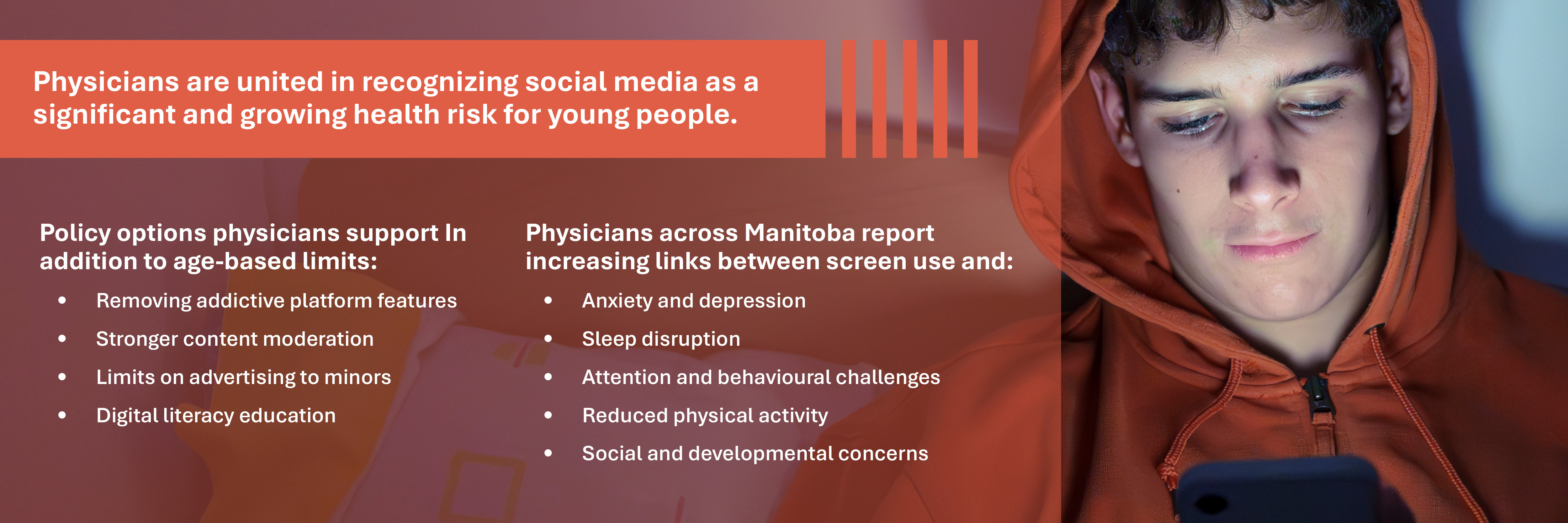
Even among strong supporters, few physicians framed an age-based ban as a complete solution. Asked about policy options, 69.4% backed the ban itself, but a nearly equal 67.1% endorsed the targeted removal of addictive platform features such as infinite scroll. Stronger content moderation, advertising restrictions for minors, and digital literacy education each drew the support of roughly four in 10.
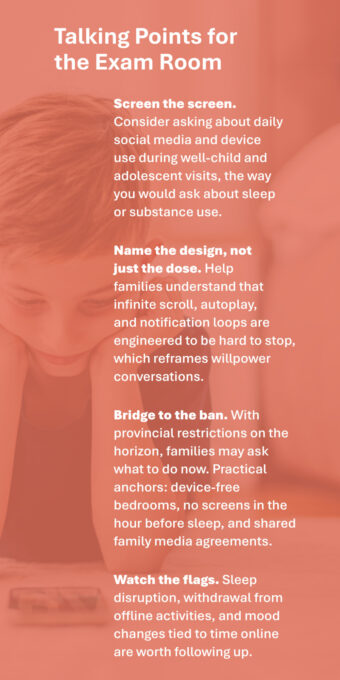
In written comments, one physician compared social media’s addictive pull to substance use and gambling, products society already gates by age. Another argued the moment had come to take back control from platforms that had grown rich while leaving young users worse off. But many tempered the call for restriction with a call for preparation, insisting that a ban must be paired with education so that young people are ready to navigate these tools safely when the restrictions lift.
A minority remained skeptical. Some doubted whether a province the size of Manitoba could meaningfully ban major international platforms. Others worried that a ban alone might leave teens unprepared for eventual access, or that legal, ethical, and privacy hurdles could complicate implementation. A few noted that social networks, with their sharpest risks removed, can offer real benefits to older youth by easing isolation and fostering connection.
A moment of policy momentum
Chief Provincial Public Health Officer Dr. Brent Roussin flagged a growing challenge in youth mental health, tied to early and widespread social media use, in the 2025 Health Status of Manitobans Report. The U.S. Surgeon General has called social media’s effect on youth an urgent public health concern. The Canadian Paediatric Society has argued it is no longer fair to place the burden on families alone, calling instead for platform safeguards and government standards.
Australia has implemented a full ban for those under 16. France is pursuing one for children under 15, alongside several other EU members. Brazil now requires age verification and parental consent and mandates the removal of addictive features. China requires a minor mode with content filters, time limits, and curfews. In the United States, more than 1,000 school districts and at least 40 states have taken social media companies to court. Roughly 75 per cent of Canadian adults support a full ban for those under 16, and both the federal and Manitoba governments have signaled they intend to act.
The Manitoba Pediatric Society has added its voice. “As pediatricians, we see the direct impact that social media access has on development and mental health,” said its President, Dr. Meghan Cranston. “We owe it to our kids to protect them from the online safety risks of social media.”
What it means for your practice
For Manitoba physicians, the report is more than a snapshot of professional opinion. It is a signal that the profession is prepared to speak with one voice on an issue that, until recently, was left to parents to monitor. “This is an emerging public health issue where physician insight matters — because we are seeing the impacts every day.”
As provincial policy takes shape, physicians will likely be asked, by patients, by families, and by government, where they stand. This report offers a clear answer, and the evidence base behind it.
Doctors Manitoba notes the survey was voluntary and reflects the perspectives of participating physicians. The full report here.