Recruitment Soaring, Retention Needs Attention

By Katiana Krawchenko
This year’s 2025 Physicians in Manitoba report shows a significant improvement in Manitoba’s doctor shortage, particularly for family physicians, due to strong success in attracting more physicians to the province. However, the research also shows serious challenges with retaining doctors in Manitoba.
The report draws on national reporting from the Canadian Institute for Health Information along with provincial data to understand trends, concerns, and opportunities related to Manitoba’s physician resources.
Progress on Recruitment
“Manitoba is climbing out of a record physician shortage, thanks to strong recruitment efforts and record increases over the last two years,” said Dr. Nichelle Desilets, President of Doctors Manitoba. “It took years for the shortage to get as deep as it was, and we are digging out faster than we anticipated.”
The report found:
- Manitoba had a record-breaking net increase of 164 doctors last year.
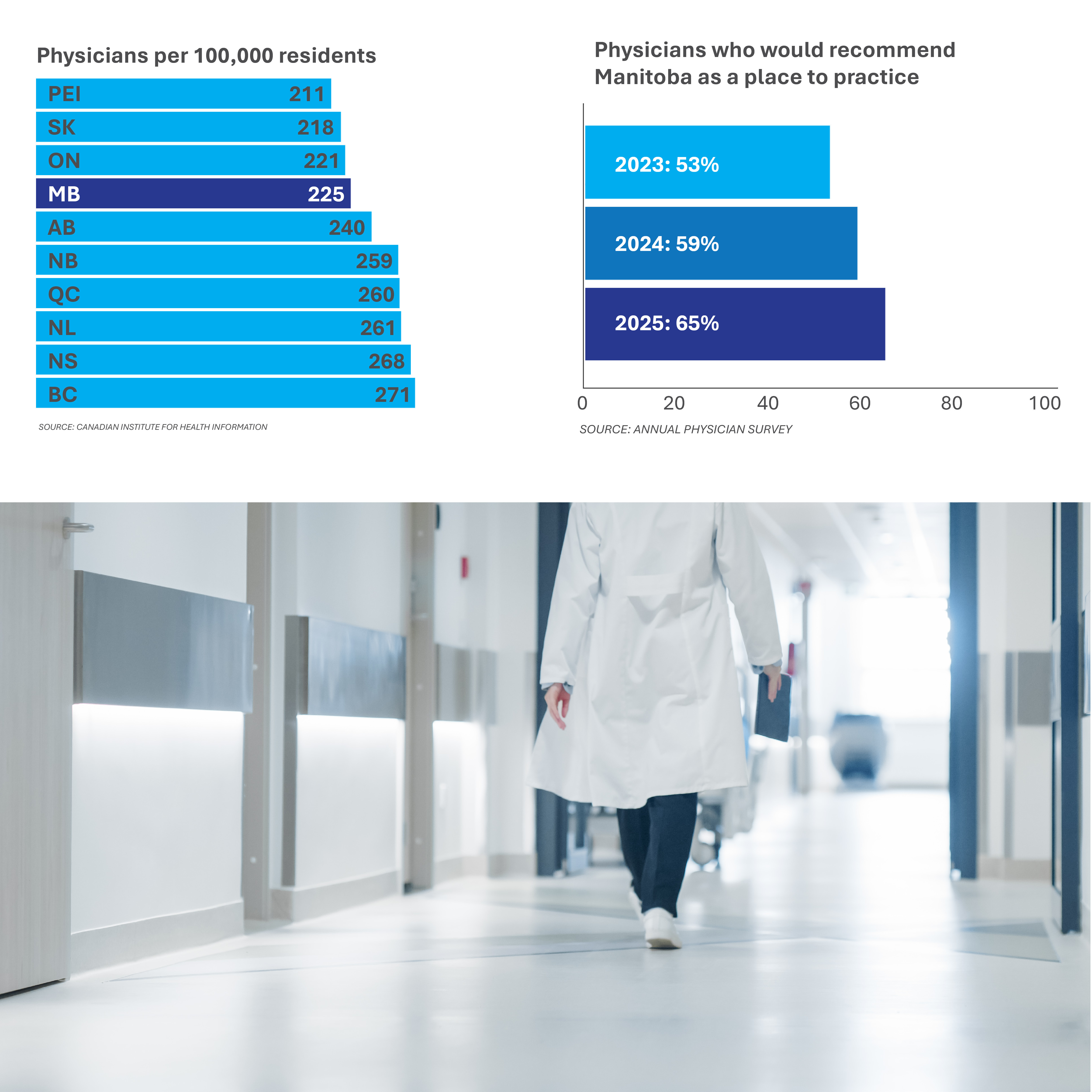
- Manitoba now has 225 physicians per 100,000 people, a 2.5% improvement over last year that moves the province closer to the national average of 241.
- Manitoba needs 246 more doctors to meet the national average, down from a record high of 445 just two years ago.
- Some sub-specialized areas are still very stretched with significant shortages.
Retention Risks
While Manitoba made strong progress on recruitment, this year’s research reinforces the need to focus on improving our efforts to retain the doctors we have. Manitoba loses more doctors to other provinces than we gain, and Manitoba appears to be retaining fewer local graduates, both flags that need to be addressed to avoid seeing our shortage grow again.
In 2024, Manitoba saw a net loss of 8.3 physicians per 1,000 to other provinces, the second worst performance of all provinces, according to analysis of data from the Canadian Institute for Health Information.
Retention is a serious concern, and the 2025 Physicians in Manitoba report found:
- 43% of doctors are considering reducing their hours, retiring, or leaving Manitoba in the next three years.
- Only 60% of students and residents are planning to stay in Manitoba, with the other 40% planning on leaving or undecided on their plans.
- 56% of physicians are experiencing distress and 48% are experiencing high rates of burnout.
Manitoba Health Minister Uzoma Asagwara said the numbers are moving in the right direction, but more work is needed. “It’s not at the level of improvement that we want to see but we know that changing that trend takes time,” they said.
“We’ve done the work of expanding medical residency training seats [in Winnipeg], and we’ve done that also in Brandon so that rural learners have the opportunity to train in their communities, close to home, and be more likely to stay and serve in those communities,” said Minister Asagwara.
They said the government is also looking into ways to help reduce physician burnout, including by reducing administrative burdens, something Doctors Manitoba advocates for at every turn.
“Frustration about broader issues within Manitoba’s health care system like excessive administrative burden, siloed electronic record systems, and a lack of access to equipment and facilities are key drivers of physician burnout and distress, and thus major reasons why they are planning to leave the province,” explained Dr. Desilets. “We need to see continued investment in these areas to provide physicians with the support they need and deserve. Broader supports for physicians lead to better patient outcomes and a healthier medical system in Manitoba.”
While a stronger focus on retention is clearly needed, a related indicator is moving in the right direction. More and more physicians would recommend Manitoba as a place to practice to colleagues.
Over the last several years, Doctors Manitoba has led initiatives focused on improving physician health and well-being through early career physician support, a robust mentorship program, physician leadership training, enhanced peer and physician mental health support and continued advocacy to reduce physicians’ administrative burden.