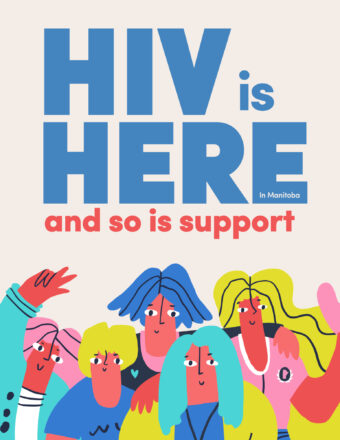
HIV is HERE

with Dr. Joshua Aquin and Dr. Sarah Lesperance
Manitoba continues to face one of the highest and fastest‑growing HIV rates in Canada. Provincial surveillance shows 291 newly diagnosed cases in 2024, a 2.83 per cent increase over 2023 and more than triple the 90 new infections recorded in 2019. Testing volume remained steady year over year, yet test positivity rose from 0.62 per cent to 0.70 per cent. The age‑standardized rate climbed from 6.3 per 100,000 in 2019 to 19.1 in 2023, remaining elevated at 18.8 in 2024. Public Health Agency of Canada data indicate Manitoba had the second highest HIV infection rate in Canada in 2024, at 19.5 per 100,000. The Manitoba HIV Program has warned that without accelerated prevention and linkage to care, annual new infections could reach 1,080 by 2028.
Why it is happening
A growing share of cases involves people facing significant social and structural barriers. “There has been a dramatic increase in cases,” said Dr. Joshua Aquin, Medical Officer of Health serving the Winnipeg region. “The population it is affecting includes those who are facing social and systemic barriers.” Many individuals are presenting late, with complications of advanced HIV. Some are lost to care entirely after a positive test.
Housing insecurity, racism, stigma, and untreated mental health or substance use challenges compound risk. “There is a history of colonization and stigma and racism behind structural inequities that present challenges,” said Dr. Sarah Lesperance, Medical Officer of Health. For many patients, basic survival needs come first. “When you are unstably housed, where you are going to sleep or have your next meal are more pressing issues,” added Dr. Aquin.
Crystal meth use, particularly when injected, increases risk through shared needles. Sexual transmission risk rises when substance use intersects with lack of access to condoms or safer sex supplies. Stigma also suppresses prevention. Some individuals fear testing because of confusion about non‑disclosure laws or worry about being blamed for exposing a partner. Shame and fear can also prevent harm‑reduction conversations within relationships.
Shifting public awareness: HIV is Here
To confront stigma and outdated beliefs, the WRHA Healthy Sexuality and Harm Reduction team, Nine Circles Community Health Centre, and community partners launched HIV is Here, a colourful, community‑driven public campaign developed through eight focus groups and five community service agencies. The goal is to normalize conversation, correct myths, and underline that HIV is treatable and that undetectable equals untransmittable.
“We found outdated perceptions of HIV as an untreatable, terminal illness, or as a ‘gay disease,’” said Dr. Lesperance. “People said, ‘Nobody talks about HIV anymore.’” The campaign emphasizes practical prevention and low‑barrier testing in settings where people feel safe. “Harm reduction is a pathway to prevention,” said Dr. Aquin. Testing is available through community organizations, in emergency departments, and in correctional facilities. “People learn about their diagnosis where they can also find support,” he said.
Street outreach is critical to closing gaps. Andrea Farrell, a public health nurse with Street Connections, noted that trust builds over time. “Many don’t understand there are treatments and preventative measures, even though they are hearing more about rising cases.” Relationship‑based supply distribution, peer involvement, and welcoming environments help counter the reality that many find clinical spaces intimidating.
What physicians can do now
First, make HIV testing routine. Incorporate it into primary care visits using Manitoba’s testing guidance and apply opt‑out or risk‑based approaches as context allows. Second, talk openly about sexual health and well‑being. Normalize the conversation for patients of all genders and ages, with special attention to people who use injection drugs, people experiencing homelessness, and Indigenous patients who may carry additional burdens due to intergenerational trauma and ongoing racism.
Third, prescribe and promote PrEP. Manitoba offers pre‑exposure prophylaxis at no cost for individuals without full insurance coverage. Eligibility is broad and includes people who inject drugs, people with multiple partners, and those with partners living with HIV. Uptake remains limited, so proactive offers can prevent infections. Fourth, anchor care in U=U. Sustained antiretroviral therapy that achieves and maintains an undetectable viral load prevents sexual transmission. The task for the health system is consistent linkage and re‑linkage to care.
Finally, use the Manitoba HIV Program’s primary care recommendations to manage adults living with HIV in community practice. Many aspects of HIV care are protocol‑driven and straightforward, particularly when clinicians partner with specialist teams. “We want primary care doctors to see that with the protocols, caring for someone with HIV can be straightforward,” said Dr. Aquin, while acknowledging the real demands in busy practices.
Closing gaps together
“Community partners are outstanding,” said Dr. Aquin. “Community organizations are leading the charge.” Physicians can amplify that work by reducing barriers in their own practices, offering same‑day testing when possible, integrating brief conversations about substance use and sexual health, and ensuring warm handoffs to community supports. For patients who are unstably housed or navigating substance use or mental health challenges, compassionate persistence matters. It can take time for someone to come to terms with a life‑changing diagnosis. Meeting patients where they are, with practical help and non‑judgmental care, keeps the door open to prevention, treatment, and better outcomes.
By the numbers
- 99,849 HIV tests in 2024, similar to 2023 volume
- Test positivity rose from 0.62% to 0.70%
- 291 new diagnoses in 2024, up 2.83% from 283 in 2023
- Age‑standardized rate: 6.3 per 100,000 in 2019, 19.1 in 2023, 18.8 in 2024
- Highest age‑specific rate in 2024: ages 30 – 39 at 50.6 per 100,000
- Manitoba had the highest HIV rate in Canada in 2024 excluding Quebec at 19.5 per 100,000 (PHAC)
Clinical quick hits for primary care
- Offer routine HIV testing, including opt‑out where feasible
- Start or refer for PrEP; coverage available for those without full insurance
- Use the Manitoba HIV Program Primary Care Recommendations for adults living with HIV
- Reinforce U=U and support adherence to sustain undetectable viral load
- Re‑engage patients lost to care with warm, low‑barrier pathways
Where to refer and learn more
- Street Connections outreach and testing
- Manitoba HIV Program testing guidelines
- Primary Care Recommendations for Adults Living with HIV in Manitoba
- Manitoba surveillance report (2024) and PHAC national highlights for context
HIV is Here: What patients need to hear
- HIV is treatable.
- Undetectable equals untransmittable.
- Testing is available in community, emergency, and corrections settings.
- Harm reduction works. Safer use supplies, condoms, and PrEP prevent infections.
- Care is confidential and support is available.
Learn more and download this poster here.